SentriPi — Edge Computing Cluster
Welcome to the documentation for the SentriPi edge computing cluster — a fault-tolerant, Raspberry Pi-based system for real-time threat detection at the edge.
Overview
SentriPi is a cluster of single-board computers that detects threats (smoke, mask, person, weapon, fire) via object detection on a sensor node, stores event data in a distributed file system resistant to single-node failure, and provides real-time monitoring through a web frontend. System health is tracked via Prometheus and Grafana, while sensitive events are pushed to a Telegram bot for instant notification.
The cluster's raw compute performance was evaluated using HPL LINPACK (GFLOPS), and its parallel scaling characteristics were analyzed using MPI and non-MPI (Task Distributor) approaches to validate Amdahl's and Gustafson's laws.
Hardware
Each team received an aluminum case containing the following hardware:
| Component | Quantity | Role |
|---|---|---|
| Raspberry Pi 5 (8 GB) | 1 | Master / PXE + NFS server |
| Raspberry Pi 4 | 1 | Sensor / camera node |
| Raspberry Pi 3 | 8 | Worker nodes |
| Raspberry Pi AI Camera Module | 1 | On-device object detection |
| Raspberry Pi AI HAT+ | 1 | Edge AI accelerator |
| Raspberry Pi Camera Module | 1+ | Camera input |
| Smart Gigabit Ethernet switch | 1 | Cluster networking |
| 500 GB NVMe SSD (external) | 1 | High-speed storage |
| Raspberry Pi Flash Drive USB 3.0 128 GB | 1 | Additional storage |
| MicroSD cards (32 GB) | 10 | Boot / OS per node |
| Raspberry Pi 27W USB-C PSU | 1 | Pi 5 power |
| Raspberry Pi 15W USB-C PSU | 1 | Pi 4 power |
| Anker USB power supplies (60 W / 40 W) | 1–2 | Pi 3 power |
| Micro USB power cables | 8 | Pi 3 power cables |
| RJ45 patch cables | 10+ | Network connections |
| HDMI + Micro-HDMI cables + adapters | 2 | Display connections |
| USB 3.0 card reader | 1 | SD card flashing |
| SD/MicroSD card adapters | 2 | Card compatibility |
| Spacer bolts M2.5 | Assorted | Case mounting |
| Power strip | 1 | Central power |
Software Stack
| Layer | Technology |
|---|---|
| Operating System | Raspberry Pi OS (workers PXE-booted from master) |
| Container Orchestration | Docker Compose |
| Distributed Storage | SeaweedFS (S3-compatible object storage) |
| Object Detection | YOLO (Ultralytics) — custom-trained model |
| Monitoring & Alerting | Prometheus + Grafana + Node Exporter |
| Database | MongoDB (event metadata) |
| Notifications | Telegram Bot API |
| API Communication | RESTful (JSON over HTTP) |
Architecture
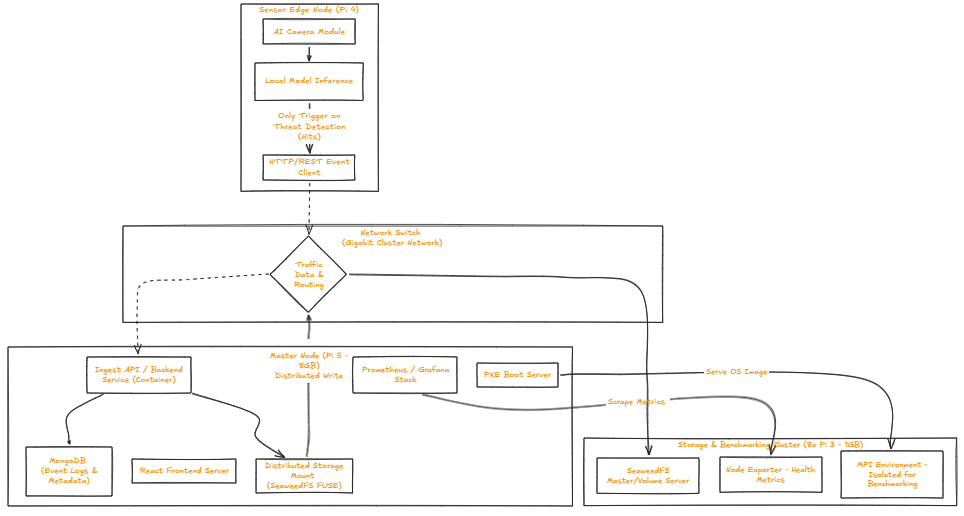
The sensor node (Pi 4 with AI Camera) captures frames and runs YOLO inference. Detection events are sent via REST to the backend on the Pi 5, which stores snapshots in SeaweedFS (distributed across Pi 3 workers) and event metadata in MongoDB. Images are served directly via a REST URL for the frontend to display. The frontend polls the REST API at a fixed interval and provides a live map with timestamps and evidence images. Prometheus scrapes Node Exporters on every node for health metrics, and a Telegram bot alerts on threat detections and infrastructure anomalies.